
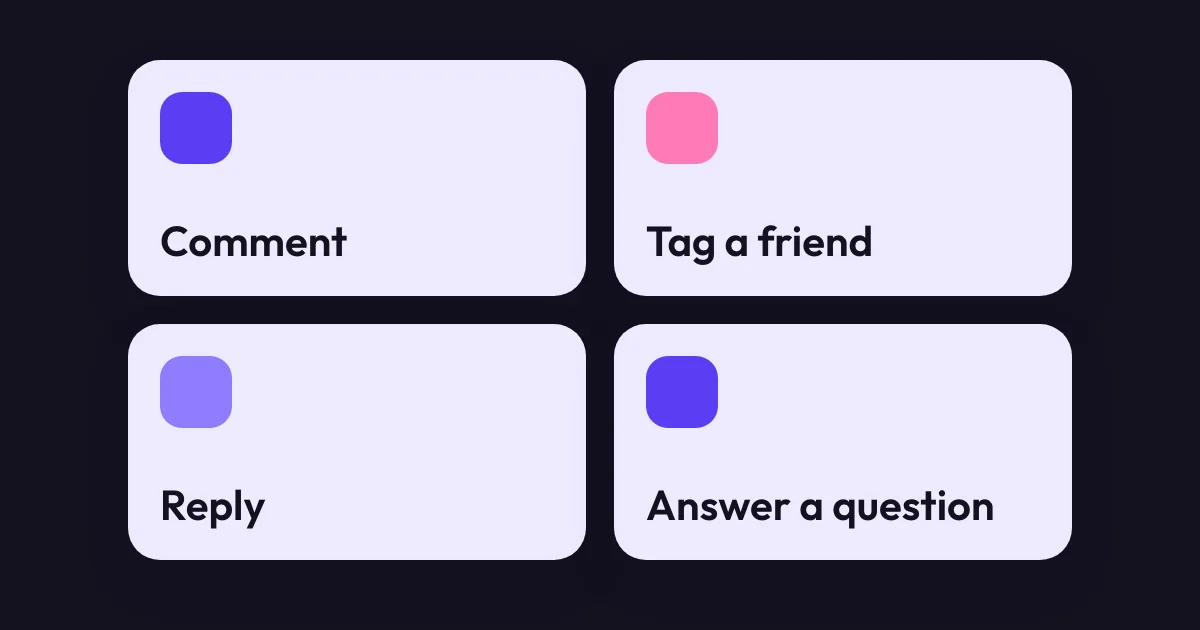
Giveaway entry methods are the things you ask people to do to enter, and the choice shapes everything that follows. This guide walks through the common options, what each one asks of entrants, how easy it is to check, and when it fits. By the end you will be able to pick one rule and write it in a single clear sentence.
Start with what you can check
Before you compare methods, ask one question: can I see who did this? If you cannot check a step, you either have to trust people or ignore the step, and both are awkward when someone asks how you picked a winner.
A comment shows up in a list. A like, a follow or a view does not. Keep this in mind below.
Comment only
What it asks: write a comment on the giveaway post. Nothing else.
Verification: easy. Every entry is a visible comment with a username, so you can export or pull the list and draw from it.
Risks: people can comment many times. Some will post a single emoji or a copy of someone else’s comment. You solve this by deciding up front that each account counts once, and removing duplicates before the draw.
When it fits: almost always, especially for a first giveaway. It is the lowest effort for entrants and the simplest for you. If you are unsure which method to pick, pick this one.
Comment and tag a friend
What it asks: comment and mention one or more friends.
Verification: you can see the tags in the comment text, so a “tag two friends” rule is checkable. You cannot confirm the friends are real people who want to be tagged.
Risks: it can turn into tag spam, where people mention strangers or the same few accounts again and again. It also asks entrants to involve people who did not agree to it. Keep the number small (one friend is plenty) and say that tagging a real friend is the point.
When it fits: when your goal is to get the giveaway in front of new people. It works best with a prize that people would honestly want to share with a friend, like tickets, a bundle or a treat for two.
Reply on X
What it asks: reply to your post. On X, the equivalent of a comment is a reply.
Verification: easy for replies, because they appear under the post. Reposts and likes are separate actions and do not show up as replies, so the same caution applies as with any other platform.
Risks: long threads get messy. Name the exact post that counts and the closing time.
When it fits: any giveaway that lives on X. For the platform-specific details, see the X giveaway picker.
Answer a question
What it asks: write a short answer to a question you set. For example, “Which book would you read first, and why?”
Verification: easy. The answer is the comment.
Risks: it takes more effort, so you will get fewer entries. If you then choose the best answer, that is a judged contest, not a random draw. Those are different things and your rules should say which one you are running. If the question is only a prompt and every answer counts, say so: “Any answer counts. Winner chosen at random.”
When it fits: when you want real replies you can learn from, such as ideas for your next product, or when you want a smaller, more engaged group of entrants.
Follow or like
What it asks: follow your account, or like the post.
Verification: this is where things break. Following, liking and watching do not appear in a comment list, so a comment-based draw cannot check them. Someone can comment without having followed, and you will not know from the list.
What to do instead: you have three honest options.
- Make it a request, not a condition: “Following us is welcome but not required.”
- Check winners only: say that the winner’s follow will be checked after the draw, and that a winner who does not meet the rule may be replaced by a backup.
- Drop the step and use a rule you can verify from the comments alone.
When it fits: when growing your audience matters and you are comfortable with a check that happens after the draw.
Repost or share
What it asks: share the post to their own feed or story.
Verification: hard. A share on a private or expiring surface cannot be seen by you, and one on a public surface is difficult to match back to an entry list.
Risks: you end up trusting entrants or reviewing screenshots, which take time and can be faked.
What to do instead: ask the entrant to paste a link to their share in the comment, or skip the step. If you ask for links, say that entries without a working link do not count.
When it fits: small giveaways where you are happy to check each entry by hand.
Use a hashtag
What it asks: post something with a specific hashtag, or add it to a comment.
Verification: moderate. You can search the hashtag, but results can be incomplete, private accounts will not appear, and posts may be hidden or deleted by the time you look.
Risks: hashtags can be misspelled, and the tag may already be in use by others. Pick a short, unique one, and say that only posts using the exact tag count.
When it fits: user-generated campaigns and events, where a shared tag also helps you gather the posts in one place.
Post your own photo or video
What it asks: create and share original content, such as a photo of the product in use.
Verification: you can see the posts, but you have to collect them by hand.
Risks: this one carries the most to think through.
- Permission: if you want to repost an entrant’s photo, say so in the rules and ask for clear consent. Do not assume entering gives you the right to reuse their work.
- Fairness: a photo contest usually involves judging, which is not random. Say what you are judging on, or run a random draw among all valid entries.
- Effort: it asks a lot, so the prize should match it.
When it fits: when your goal is content from fans and you have the time to review entries.
Sign up to an email list
What it asks: enter an email address to take part.
Verification: easy, because you hold the list.
Risks: privacy and consent rules apply, and they vary by country and region. This is not legal advice, so check the rules where you and your entrants live. As a general practice, make the sign-up clearly optional, say plainly what the emails will be, and keep entry possible without joining the list if you can. People should never be signed up to something they did not clearly agree to.
When it fits: when your goal is new subscribers and you have a real email you plan to send. If you collect addresses, use them for what you said you would.
Refer a friend
What it asks: bring someone else to join, follow or sign up.
Verification: only possible if you have a system that tracks referrals. A comment list cannot show it.
Risks: it rewards whoever pushes hardest and can lead to spammy messages.
When it fits: rarely, and mostly for larger campaigns with the means to count referrals. For most creators, skip it.
A framework for choosing
Now that you have seen the options, use these five rules to decide.
- Start from your goal. More comments? Choose comment only, or answer a question. New email subscribers? Use an optional sign-up. Content from fans? Ask for a photo or video with a hashtag.
- Prefer fewer steps. Each extra step loses entrants and adds things you must check. One step is usually enough. Two is a lot.
- Prefer rules you can verify. If you cannot see it, either drop it or say how you will handle it.
- Match the platform. Use comments where people comment, replies on X, and so on. For platform-specific pointers, see our guide to social media giveaways.
- Avoid rules that reward spam. If more entries means more chances, the loudest account wins. Cap it at one entry per person.
Promotion rules differ from platform to platform and change over time. Read the current ones before you launch, and write yours to match. Our post on giveaway rules covers what to put in writing.
Three example setups
These are hypothetical examples to show how the framework works.
Example 1: the small bakery
Imagine a bakery that wants more people in the shop this month. The goal is local attention. The prize is a box of treats, and the entry rule is: “Comment with your favorite pastry. One entry per person. Winner picked at random on Friday at 6 p.m.”
One step, easy to verify, and the prize is something a local person wants. There is no follow requirement because the baker cannot check it from comments.
Example 2: the newsletter writer
Imagine a writer who wants more people to subscribe to a weekly letter. The goal is subscribers. The prize is a signed book. The rule: “Enter by commenting. Optionally, subscribe to the newsletter. Subscribing is not required and does not change your chances.”
The optional sign-up keeps the draw fair and the list clean. Anyone who subscribes does so because they want the letters.
Example 3: the outdoor gear brand
Imagine a brand that wants photos of its backpacks on real trips. The goal is content from fans. The prize is a trail kit. The rule: “Post a photo of your pack outdoors with #ourpackstory. By entering, you agree we may share your photo with credit. One entry per person.”
Here the permission is stated in the rule, the hashtag keeps entries together, and the brand can choose to draw at random from all valid posts.
Check your list before the draw
Whatever method you use, clean up the entries before you pick. Remove duplicates, exclude your own account and your team, and apply any tagging rule you set. If you draw from comments, a picker can do this for you. TweetGift works from a pasted post link or uploaded comments, removes duplicate entries, applies a required-tags rule, and leaves out accounts such as your own. The certificate it gives shows the number of entries, the filters used and the date and time of the draw. For more on running the draw itself, read how to pick a random winner.
A checklist for the one-sentence entry rule
A good entry rule fits in one sentence. Write yours, then test it against this list.
- It names the single action: “Comment on this post.”
- It says how many entries each person gets: “One entry per person.”
- It names the post or place where entries count.
- It gives the closing date, time and time zone.
- It says how the winner is chosen: “at random.”
- It does not depend on anything you cannot see, or it says how you will check it.
- It does not ask people to tag strangers or spam.
- If it asks for personal data or content, it says what you will do with it.
Put it together and you get something like this:
Comment on this post to enter. One entry per person. We will pick one winner at random after [day] at [time and time zone].
Draw your winner from the comments
Once your entry rule is set, pick the winner fairly and keep a record of how you did it.