
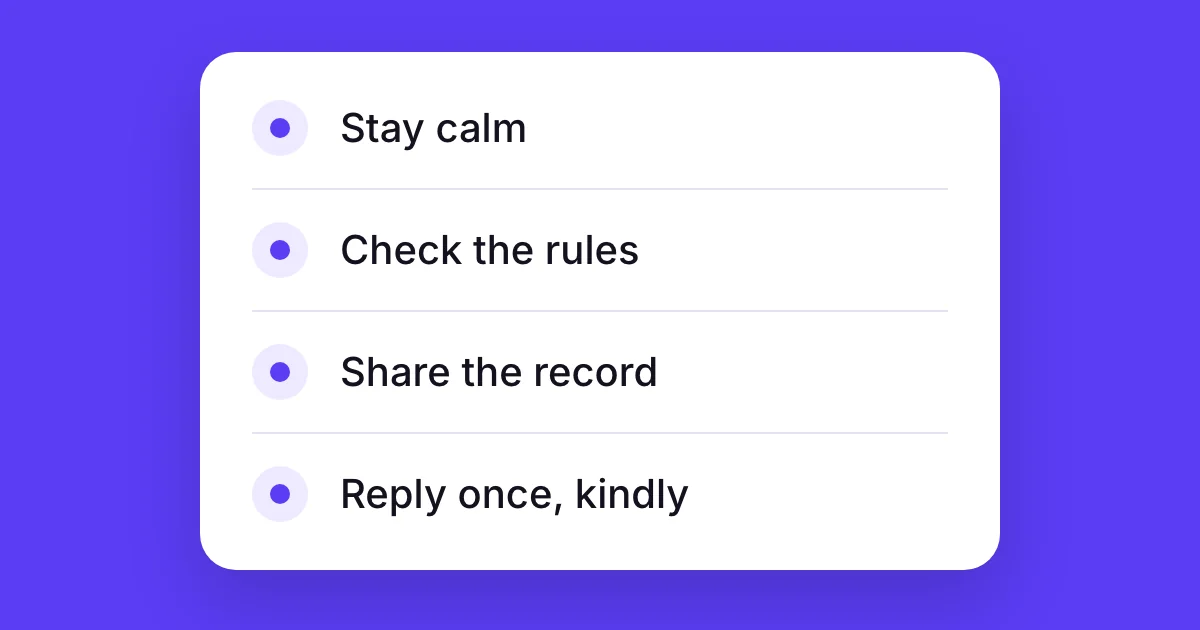
When someone makes an unfair giveaway claim, you can handle it calmly with a plan: pause, work out what happened, reply with facts, fix real mistakes and protect yourself from abuse. This guide walks you through each step and gives you five reply templates to copy.
Take a breath first. A complaint about an unfair giveaway feels personal, but it is usually a question in disguise. Most of the time you can answer it with the rules you already wrote.
Why people say a giveaway was unfair
Knowing the cause helps you pick the right response. People usually say a giveaway was unfair for one of three reasons.
- They misread the rules. They thought a story reply counted, or that entries were open until midnight, or that following was a requirement. The rules were there, but they did not take them in.
- They are disappointed. They wanted the prize and did not win. Disappointment can come out as an accusation, even when nothing went wrong.
- You made a real mistake. It happens. A closing time was unclear, a duplicate slipped through or your own account was in the list.
You cannot tell which of these it is from the tone of the message. That is why the first move is to slow down.
Step 1: pause before you reply
Do not answer in anger, and do not answer in the first ten minutes. A fast reply tends to be defensive, and a defensive reply looks like guilt.
Here is a short routine that works.
- Read the complaint twice. Underline the actual claim: what exactly do they say was unfair?
- Close the app. Get a drink of water or take a short walk.
- Open your giveaway post and read your own rules as if you were a stranger.
- Open your proof, such as your entry count, your filters and the time of the draw.
- Only then decide on a reply.
If other people are piling on, you do not have to answer every comment as it arrives. One calm, clear reply in the right place is better than ten quick ones.
Step 2: work out which situation you are in
Before you write a word, sort the complaint into one of three groups. Each needs a different reply.
A misunderstanding of the rules
The person says something the rules already answer. For example, they say the giveaway closed early, but your post says the closing time, with a time zone. Check the wording. If the rule was clear, this is a misunderstanding. If the rule could be read two ways, that is part of the problem, and you should admit it.
A genuine mistake on your side
Check honestly. Ask yourself these questions.
- Did you include your own account or your team’s accounts in the draw?
- Were duplicate entries left in the list?
- Did the closing time pass before you drew, or did you accept entries after it?
- Did you change the rules after people entered?
- Did you miss a valid entry that should have counted?
If the answer to any of them is yes, you have a real mistake. Skip ahead to step 4 in your mind and plan your fix.
Bad-faith criticism
Some people want a fight. They may insult you, repeat the same claim after you have answered it or demand an answer that no evidence could satisfy. A sign of bad faith is that a calm, factual reply does not change anything. You still reply once, politely, for the benefit of everyone reading. After that, you set boundaries, which we cover in step 5.
Step 3: respond with facts
Whether it is a misunderstanding or a misreading, the best reply is short and made of facts. Point to what is already written and recorded. Good facts to have ready:
- The written rules. Link to the post or quote the exact line.
- The closing time. Date, time and time zone.
- The entry count. How many entries were in the draw.
- The filters used. For example, duplicates removed and your own account left out.
- The date and time of the draw.
- The certificate, if you have one. A winner certificate that shows the number of entries, the filters used and the date and time of the draw is easy to link to and hard to argue with. If you used a tool such as TweetGift, share that. If you drew another way, share the record you kept.
If you do not have a record, be honest about that too. Explain how you drew and what you remember. Then keep a proper record next time. Our guide to how to pick a random winner explains what to save.
Keep the tone kind. You are not trying to win an argument. You are trying to show that the process was open and that you followed it.
Step 4: if you made a mistake, say so plainly
This is the step that protects your reputation. People forgive honest errors. They do not forgive cover-ups.
- Say what went wrong, in one sentence. No excuses and no long story.
- Say what you are doing about it. Choose a fix you can actually deliver. Examples: draw an additional winner, if your rules allow it. Honor the entry that was missed. Redo the draw with the corrected list, and say why.
- Say when it will happen. Give a date.
- Do not delete comments to hide the mistake. Deleting looks like hiding, and screenshots exist. Leave the original comments and add your correction.
- Thank the person who pointed it out. They helped you fix it.
Be careful with redraws. A redraw is reasonable when your rules cover it, or when the first draw was clearly faulty. It is not a way to change a result you did not like. If a winner was drawn correctly, they keep the prize, and your fix may be an extra prize or a second winner instead. If you are not sure what to do, look at what your written rules say first. Our post on giveaway mistakes covers the common ones.
Step 5: set boundaries for abuse
Honest questions deserve answers. Abuse and harassment do not.
You can stay open to both at once. Here is how to tell the difference: a question asks for information, and abuse attacks you or others.
- Reply once to the question behind the anger, if there is one.
- Use the platform’s tools. Report abusive comments, mute the person or block them. Each platform offers its own tools, and they change, so look at what is available in your app.
- Do not argue in a thread that has turned nasty. Silence is allowed.
- Protect your team. If someone else manages your account, tell them what the plan is, so they do not reply in a heated way.
- Do not delete honest criticism. Hide or remove only abuse, threats and spam. Keep polite complaints visible and answer them.
Five reply templates
Copy these and fill in the placeholders. Adjust the wording so it sounds like you.
1. The person misunderstood the rules
Hi [name], thanks for asking. The rules in the post said [quote the rule], and the giveaway closed on [date] at [time and time zone]. Entries after that time could not be counted. I am sorry that was not clear enough. I will make it easier to spot next time.
2. “Why wasn’t I picked?”
Hi [name], thanks for entering. We had [number] entries and drew [number] winner(s) at random on [date] at [time]. I know it is disappointing not to win. I hope you will join us for the next one.
3. A mistake you made, acknowledged
You were right to ask. We made a mistake: [one sentence on what went wrong]. To fix it, we will [the specific fix] by [date]. The original post and comments stay as they are. Thank you for pointing it out, [name].
4. A request for proof
Fair question. Here is the record of the draw: [link to certificate or proof]. It shows [number] entries, the filters we used ([list]) and the date and time of the draw. The rules are here: [link]. If anything still looks wrong, tell me what you see and I will look at it.
5. An abusive comment
I am happy to answer honest questions about the giveaway, and the rules and proof are here: [link]. I will not reply to personal attacks, and I may mute or remove comments that cross that line.
You do not have to post templates word for word. They are a starting point. Short, calm and specific always beats long and defensive.
How to prevent the problem next time
Most complaints about an unfair giveaway are avoidable. Do these things before the next one.
- Write the rules in full before you post. Our guide to giveaway rules has a checklist.
- Pick rules you can check. If your list of comments cannot show following or liking, do not make them requirements, or say how you will handle them. See giveaway entry methods.
- State the closing time with a time zone. Then actually close at that time.
- Draw randomly and keep a record. Remove duplicates, leave out your own account and your team, and save the entry count and the time of the draw.
- Have a backup winner and a reply deadline in your rules.
- Announce with the proof attached. Our post on how to announce giveaway winners shows what to include.
- Follow the platform’s current promotion rules. They change, so check them each time.
If you want a simple setup that does the filtering and saves the record for you, the Instagram giveaway picker works from a pasted post link, and the other platforms have their own pages too. Our guide to running a fair Instagram giveaway puts the steps in order.
A calm reply and a clear record go a long way. A written record often settles a dispute once people can see the facts for themselves.
Keep a record you can point to
Draw your winner from a pasted post link, and get a certificate with the entry count, the filters and the date and time. Free for one winner from up to 300 comments on a single post.