
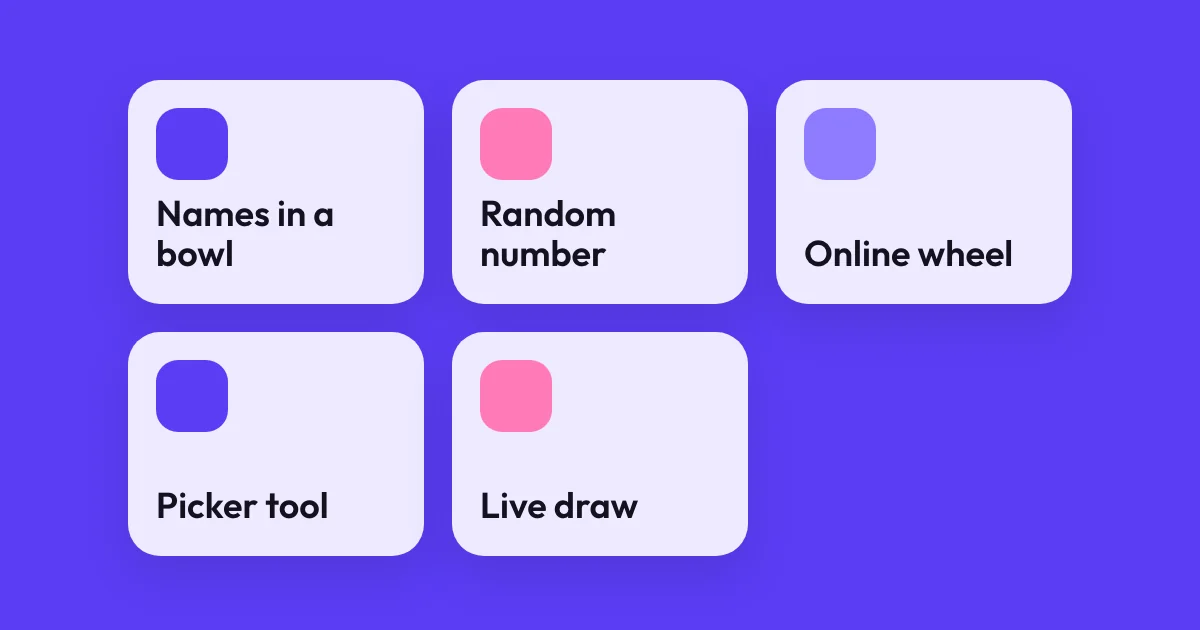
You can pick a random winner in five minutes, but doing it fairly and being able to show it is what people remember. This guide compares five methods, explains how to prepare your entry list, and tells you what proof to keep so nobody has to take your word for it.
What “random” means for a giveaway
A random draw means every valid entry has the same chance, and you do not get to nudge the result. That is the whole idea. If you scroll through the comments and pick one you like, that is a choice, not a draw.
Choosing a favorite is perfectly fine if you say so. Many accounts run “best comment wins” or “best photo wins” giveaways. Just do not call them random. Put the difference in your rules in plain words:
Winner is chosen by [the host] based on [the best answer / the most creative photo]. This is a judged giveaway, not a random draw.
or
Winner is chosen at random from all valid entries. Every valid entry has the same chance.
Pick one and stick to it. If you are writing the rules now, our giveaway rules guide covers what else to include.
Prepare the list before you draw
Every method below works better when the list is clean. Do this first, whatever method you choose.
- Fix the closing time. Draw only after the time you promised. Entries that arrive later do not count, and saying so in advance avoids arguments.
- Remove duplicates. If your rule is one entry per person, a person who commented five times still gets one slot. Otherwise they have five times the chance.
- Leave out your own account. Your replies in the comments are not entries. The same goes for your team, your partner brand and anyone who is not allowed to win under your rules.
- Apply your rules to the list. If you asked people to tag a friend, remove comments without a tag. Check only what you can actually see.
- Write down the count. Note how many valid entries are left. You will want that number later.
One honest limit: a comment list shows who commented. It cannot show who follows you, who liked the post or who watched the video. If your rules require those actions, you cannot verify them from comments, so say how you will handle that, or drop the requirement. Our guide to giveaway entry methods goes into this.
Method 1: names on paper in a bowl
The classic. It is physical, easy to understand and needs nothing but paper.
How it works
- Write each valid entrant’s handle on its own slip of paper.
- Fold every slip the same way so none stands out.
- Mix them in a bowl or a hat.
- Without looking, pull one slip. Pull extra slips if you have more winners or backups.
- Photograph or film the pull, with the bowl and the slip in view.
What it is good at
It is easy to follow and needs no internet. It suits a small in-person event.
Where it goes wrong
Slips can stick together or get left out, and nobody can check that every entrant got a slip.
At hundreds of comments
It does not scale. Use it for small lists.
Method 2: a numbered list and a random number generator
This is the do-it-yourself digital version, and it is more reliable than it sounds.
How it works
- Copy the valid entries into a spreadsheet, one per row, after you have removed duplicates.
- Number the rows from 1 to however many entries you have.
- Generate a random whole number in that range. A spreadsheet can do this with a random-number formula, or you can use a random number generator website.
- Find the row with that number. That entrant is the winner.
- For extra winners, generate more numbers and skip any you have already used.
- Take a screenshot of the list, the count and the number you drew.
What it is good at
It is cheap and transparent. Anyone who sees the list and the number can check the match. It handles any list size once the entries are in the sheet.
Where it goes wrong
The weak point is getting entries into the sheet. Copying comments by hand is slow and easy to get wrong. A spreadsheet formula that recalculates every time you open the file can also change your result, so save or screenshot the number the moment you draw it.
At hundreds of comments
The draw itself scales fine. The copying does not. Expect to spend most of your time collecting and cleaning the list.
Method 3: an online wheel or spinner
A wheel is fun to watch, and it works well on a screen share or in a video.
How it works
- Paste your cleaned list of handles into the wheel tool.
- Spin it.
- Record the spin from the start so viewers see the list loaded and the result land.
- Remove the winner from the wheel before you spin again for backups.
What it is good at
It is quick and visual.
Where it goes wrong
A wheel does not clean your list. If duplicates or your own account are on it, they are in the draw. A spin you did not record is hard to prove later.
At hundreds of comments
It becomes hard to read and easy to paste wrongly. Treat it as a good fit for small lists and showmanship.
Method 4: a dedicated giveaway picker
A giveaway picker is a tool built for this one job. It reads the entries, cleans them and draws for you.
How it works
In general, you give the tool your entries (from a post link or an uploaded list of comments), set your rules, and run the draw. Good pickers do these things:
- Draw a random winner from the entries.
- Remove duplicate entries so each person counts once.
- Apply a required-tags rule, such as “must tag a friend”.
- Leave out accounts you choose, like your own.
- Draw several winners and backups in one go.
- Give you a record of the draw.
TweetGift works this way. You paste a post link or upload comments, you do not need to share a password, and the winner certificate shows the number of entries, the filters you used and the date and time of the draw. There are platform pages for Instagram, TikTok, YouTube, X and Facebook. The free plan draws one winner from up to 300 comments on a single post, and pricing covers the rest.
What it is good at
It handles the cleaning, which is where most of the manual risk lives. It also leaves a record you can show.
Where it goes wrong
A picker can only work with the entries it is given. If a post has hidden or removed comments, or your rule depends on a follow or a like, the tool cannot see that. You still need clear rules and a sensible closing time.
At hundreds of comments
This is where it earns its place. The work that takes an hour by hand takes a few minutes.
Method 5: a live draw on video
A live draw is less a separate randomizer and more a way of showing any of the other methods in real time.
How it works
- Announce the draw time in your rules, with a time zone.
- Go live or record a video. Show the entry count and the closing time first.
- Run the draw on screen with one of the methods above: the bowl, the spreadsheet, the wheel or a picker.
- Say the winner’s handle out loud, and say what happens next.
- Save the video, or a clip of the draw, so people who missed it can watch.
What it is good at
People can watch it happen, which builds trust. It also gives you content and a moment of attention.
Where it goes wrong
Going live does not make a draw random. A host can still pick a favorite on camera. Technical problems, a missed stream and time zones can leave entrants out. If the video is the only record, you also have no saved entry count unless you say it on screen.
Ties, several winners and backups
Plan these before you draw.
Ties. In a random draw there are no ties, because each draw selects a single entry. A tie only appears in a judged giveaway, where two entries seem equally good. Say in the rules how you will break it, for example by drawing at random between the tied entries.
Several winners. Decide the number in advance. Draw them one at a time without putting a winner back in the pool, so nobody wins twice unless your rules allow it.
Backups. Draw one or two backups at the same moment as the main winner, and note the order. If the first winner cannot take the prize, you move to the next without another draw. Your rules should say how long a winner has to reply before a backup is used.
When a redraw is acceptable
A redraw is acceptable when your published rules say it can happen and the reason is one of those rules. Typical reasons:
- The winner is disqualified because they broke a rule.
- The winner does not reply by the deadline you stated.
- The winner declines the prize.
In those cases, move to your backup, or draw again from the same list, and tell people what happened.
A redraw is not acceptable because you did not like who won. If the result changes, say so publicly and say why.
What proof to keep
Keep a small record in one folder or document. Anyone who asks should get a calm, factual answer.
- The rules exactly as they were when the giveaway ran.
- The closing time, with the time zone.
- The number of valid entries after cleaning.
- The filters you used, like duplicates removed or required tags.
- The date and time of the draw.
- A screenshot or recording of the draw itself.
- The winner, the backups and the order.
You can save this by hand. A certificate from a picker records the entry count, filters and time for you. Either way, share a link or image when you announce giveaway winners. If a complaint comes up later, our guide to what to do when someone says a giveaway was unfair shows how to answer it.
Which method should you use?
Use this as a starting point.
- A handful of entries in person: the paper bowl. Film it.
- A small online giveaway and you like spreadsheets: a numbered list and a random number generator. Save the number.
- Entertainment on a stream, with a short list: a wheel, recorded from the start.
- Hundreds of comments, duplicates and rules to apply: a dedicated picker. It saves time and leaves a record.
- You want your audience to watch: do a live draw and use any of the methods above on screen.
- You are judging, not drawing: write “judged” in your rules and explain your criteria. It is not random, and that is fine.
The method matters less than a clean list, a draw you did not steer and a record you can share.
Draw your winner in a few minutes
Paste a post link or upload your comments, remove duplicates, and get a record of the draw.